

Chaste Tree and Hormonal Balance: Understanding Progesterone, Estrogen, and Natural Support
Hormonal fluctuations are a normal part of life. Yet for many women, those fluctuations can begin to feel disruptive—affecting mood, energy, sleep, and menstrual cycles.
Concerns about progesterone and estrogen balance are especially common during times of stress, in the late reproductive years, and throughout the transition into perimenopause. Cycles may shorten. Premenstrual symptoms may intensify. Sleep may become lighter. Emotional resilience may feel lower in the second half of the cycle.
Chaste tree (Vitex agnus-castus) is frequently discussed as a natural support strategy in these situations. To understand where it may fit, it helps to first understand how female hormone regulation actually works.
Common Hormonal Patterns Women Notice
Rather than focusing on diagnoses, it is often more helpful to look at patterns.
Women commonly report:
- Cycles that gradually shorten over time
- Spotting before a period begins
- Breast tenderness before menstruation
- Irritability or low mood premenstrually
- Heavier bleeding or clotting
- Fatigue in the second half of the cycle
- Difficulty sleeping before a period
These patterns are often associated with changes in progesterone relative to estrogen.
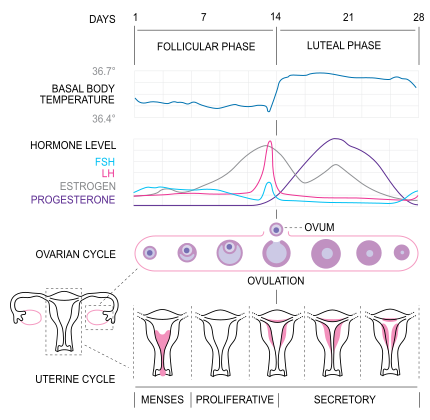
Estrogen supports tissue growth, brain signaling, and metabolic function. Progesterone, produced after ovulation, has stabilizing and calming effects on the nervous system and helps balance estrogen’s influence on the uterine lining.
When ovulation becomes inconsistent—or when stress physiology suppresses luteal signaling—progesterone levels may not rise adequately. In this context, symptoms are sometimes described as “estrogen dominance,” meaning estrogen’s effects outweigh progesterone’s stabilizing role.
How the Body Regulates Progesterone and Estrogen
Hormone balance is coordinated through the hypothalamic–pituitary–ovarian (HPO) axis.
- The hypothalamus signals the pituitary gland.
- The pituitary releases luteinizing hormone (LH) and follicle-stimulating hormone (FSH).
- These signals stimulate the ovaries to produce estrogen, progesterone, and testosterone.
Chaste tree does not contain progesterone and does not function as a hormone replacement. Instead, research suggests it influences pituitary signaling—particularly LH output—which may support healthy ovulation. Because progesterone is produced after ovulation, supporting ovulatory signaling may indirectly support progesterone levels. In this way, chaste tree works “upstream” at the level of regulatory signaling rather than supplying hormones directly.
However, reproductive hormone balance rarely exists in isolation. It is influenced by multiple systems throughout the body.
A Systems-Based View of Hormone Imbalance
From a functional medicine perspective, progesterone and estrogen patterns often reflect broader physiological inputs, and one rarely becomes imbalanced without triggering a compensation in another part of the system.
Stress and Cortisol
- Chronic stress elevates cortisol, the body’s primary stress hormone. Persistently elevated cortisol can suppress ovulation, which reduces progesterone production. Many individuals are over stressed, and under recovered.
Blood Sugar Regulation
- Frequent glucose spikes and crashes may destabilize cortisol rhythms, affect insulin resistance, and impact the HPO axis. In clinical practice, this is usually the first place we start when helping to support optimal hormonal balance – even when someone has not been diagnosed with diabetes.
Thyroid Function
- Thyroid hormones influence menstrual regularity and ovarian responsiveness. Subtle thyroid shifts can affect cycle quality. Thyroid hormones affect every cell in the body and can be an overlooked area of dysfunction when a complete thyroid blood test is not performed.
Liver Function
- The liver metabolizes and clears estrogen. If detoxification pathways are impaired, estrogen clearance may slow. Something as simple as eating more cruciferous vegetables can be a great first start in jump starting the liver’s ability to support estrogen clearance.
Gut Health
- Certain gut bacteria influence how estrogen is recycled or eliminated, a system sometimes referred to as the “estrobolome.” Microbial imbalance in the gut can lead to far more than just digestive bloating and gas.
Because these systems are interconnected, meaningful progress often requires addressing sleep, protein intake, stress regulation, micronutrient status, and metabolic stability—not just adding a single supplement.
Chaste Tree as Part of a Broader Botanical Strategy
Chaste tree has traditionally been used to support:
- Luteal phase progesterone production
- Healthy prolactin levels
- Cycle regularity
- Infertility support
Some women report improvement in premenstrual symptoms after consistent use over several months. It is generally not considered an immediate-acting botanical; regulatory changes tend to develop gradually.
Professional-grade chaste tree formulations are available through the Hayden Institute store for those interested in exploring botanical support. However, supplementation is typically layered onto foundational lifestyle strategies rather than used in isolation.
Other Botanical Supports That May Be Considered
While chaste tree focuses on pituitary signaling and ovulatory support, other herbs may be considered depending on the broader pattern present.
Adaptogenic herbs such as ashwagandha or tulsi (holy basil) are sometimes used to support stress resilience. Because chronic cortisol elevation can suppress ovulation, improving nervous system regulation may indirectly support progesterone balance.
Estrogen-modulating botanicals are occasionally discussed when symptoms suggest tissue-level estrogen sensitivity or impaired clearance. In these cases, liver support, fiber intake, and gut health are often addressed first.
Perimenopausal support herbs, including wild yam or shatavari, may be considered in certain life stages when ovarian signaling naturally shifts.
The appropriate botanical strategy depends on individual physiology, life stage, and symptom presentation. No single herb fits every pattern.

Natural Support Strategies for Hormonal Stability
Before layering in supplementation, many patients benefit from foundational steps such as:
- Ensuring adequate daily protein intake
- Supporting consistent sleep-wake rhythms
- Reducing late-night light exposure
- Practicing daily stress regulation
- Incorporating resistance training or moderate movement
- Tracking cycle patterns to identify trends
In many cases, these foundational strategies create measurable improvements in hormonal symptoms.
When Additional Help May Be Useful
If cycle irregularity, heavy bleeding, persistent mood shifts, or severe premenstrual symptoms continue despite lifestyle adjustments, further evaluation may be helpful.
Hormone concerns can overlap with thyroid dysfunction, insulin resistance, inflammatory patterns, or perimenopausal transition. A structured review of symptom history and appropriate laboratory markers may provide clarity about which systems require support.
For readers outside the Houston area, working with a qualified practitioner who understands systems-based hormone physiology may help guide safe and individualized care.
Local Next Step for Houston and Cypress Area Patients
Women in Houston, Cypress, and surrounding communities who are seeking a clearer understanding of their hormone patterns may benefit from a structured evaluation.
Some patients choose to explore a comprehensive review through the Functional Medicine services at The Hayden Institute, where symptom history, laboratory findings, nutrition, stress physiology, and botanical strategies can be evaluated together. Those interested in learning more may visit the Functional Medicine page or review the New Patients page for additional details.
Hormonal symptoms are rarely random. They often reflect coordinated shifts in signaling, metabolism, and stress physiology. Identifying those patterns can provide meaningful direction.
Closing Thoughts
Chaste tree may offer supportive value in specific contexts, particularly when ovulatory signaling requires gentle regulatory support. However, sustainable hormone balance typically involves more than a single intervention.
A broader view—one that considers brain signaling, metabolic stability, thyroid function, stress load, liver clearance, and gut health—often provides clearer long-term insight.
This article is for educational purposes only and is not intended to diagnose, treat, or cure any condition. For personalized guidance, consult a qualified healthcare professional.
